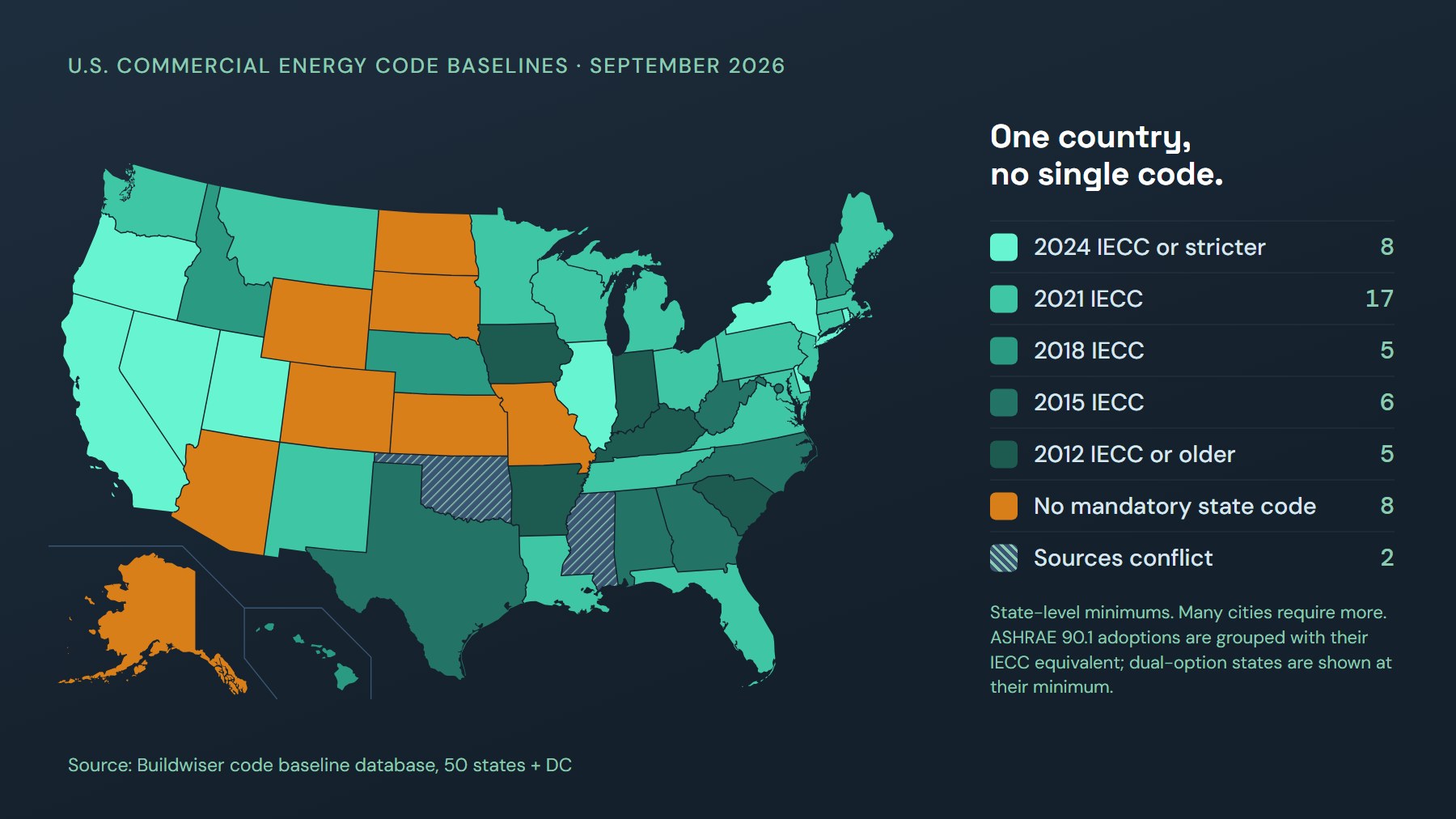
If you're building the same product type in Dallas, Denver, and one of Denver's own suburbs, you're playing by three completely different sets of rules. Energy code compliance in the United States isn't governed by a single national standard: it's a patchwork of thousands of state, county, and city jurisdictions, each with its own requirements, timelines, and enforcement. For a developer trying to scale beyond one market, that patchwork is more than an inconvenience. It's a direct tax on growth.
There Is No National Energy Code, and That's the Whole Problem
The International Code Council publishes the IECC (the International Energy Conservation Code) as a model energy code. But it's just that: a model. Every state independently decides whether to adopt it, which edition to adopt, and when. Then counties and cities layer their own amendments on top. The result is a compliance landscape with thousands of effectively distinct rule sets, each updated on its own rolling schedule.
California's Title 24 doesn't resemble Florida's energy code. Texas adopts IECC provisions on its own timeline, often lagging the national release by years in some counties and matching it almost immediately in others. Massachusetts runs one of the most aggressive above-code stretch programs in the country, layered on top of its base energy code. And within any given state, individual counties and cities can and do adopt stricter local amendments, meaning two projects thirty miles apart can face genuinely different insulation specs, HVAC sizing requirements, window performance thresholds, and documentation packages.
None of this is a temporary quirk waiting to be cleaned up. It's structural. Energy codes in the US are adopted through state and local legislative processes, not handed down from a single federal authority, and every jurisdiction has its own political timeline, its own utility and construction lobby dynamics, and its own appetite for going beyond the model code. Some states adopt each new IECC edition within a year of release. Others are still enforcing an edition from a decade ago in parts of the state, while adjacent counties have already moved on. There's no cleanup process coming: this is simply how the system is built, and it isn't changing anytime soon.
Why This Is a Standardization Killer for Developers
For a single-market developer, this is an annoyance you learn to live with. For a developer trying to build the same product type across multiple states, it's a direct obstacle to the economies of scale that make national development profitable in the first place.
Picture trying to standardize a prototype design (the same floor plan, the same building systems, the same specification package) across Dallas, Denver, and Seattle. The insulation spec that satisfies Phoenix's code doesn't satisfy Chicago's. The window performance requirement that clears California doesn't clear Florida. The HVAC approach that passes an IECC 2021 jurisdiction might fail in a jurisdiction that's already moved to IECC 2024. None of that is optional or negotiable: it's determined entirely by which side of a county line the project happens to sit on.
That means procurement teams can't standardize material orders across markets. Design teams can't build a repeatable template and simply drop it into a new city. And the compliance process itself restarts from scratch on every single project, in every new market: a new consultant relationship, a new code interpretation, a new set of assumptions to verify, every time. The developers who scale most efficiently are the ones who can replicate a proven product. The current energy code compliance process makes replication nearly impossible, because the ground keeps shifting under the one part of the process that's supposed to be a known, fixed requirement.
And because every jurisdiction's code is a living document, amended, updated, and re-adopted on its own schedule, even a developer who's built five projects in the same city can't assume the sixth one plays by the same rules. The version of the code that applied eighteen months ago may not be the version in force today.
This is also why the usual workaround, hiring a local energy consultant in every new market, only partially solves the problem. A good local consultant knows the current code in their own jurisdiction well. What they typically can't do is give a national developer a consistent, comparable read across five or ten markets at once, because that isn't their job and isn't how their business is structured. The developer ends up managing five or ten separate consultant relationships, five or ten separate interpretations of "compliant," and no single source of truth for comparing costs or strategies across markets, which defeats the entire purpose of trying to standardize a product type in the first place.
What Buildwiser Does About It
Buildwiser AI is trained on national and regional energy codes across every US jurisdiction, not a single model code, but the actual state, county, and city-level requirements that determine real-world compliance. When you run a simulation, you're not getting a generic estimate based on the IECC model code. You're getting an AI-powered analysis that reflects exactly what compliance looks like in your specific market, for your specific project type, under whatever code edition your jurisdiction currently enforces.
That means you can build the same product type in Dallas, Denver, and Seattle, run three separate simulations, and get three separate compliance analyses, each one tailored to its own jurisdiction's rules, and each one identifying the cheapest compliant path available in that specific market. No pulling code binders off a shelf. No calling a local consultant just to confirm which IECC edition your county actually adopted, or whether the amendment that applies to your building type takes precedence over the base code. No expensive surprises discovered for the first time at permit review, months after the design was finalized.
For a developer trying to operate in more than one market, that's not just a time-saver. It's the foundation that makes replicating a product type across state lines actually work, because the compliance process stops being a one-off research project and starts being a repeatable step you can run on any project, anywhere in the country, in minutes.
Frequently Asked Questions
Does the United States have one national energy code?
No. The International Code Council publishes the IECC as a model code, but adoption is entirely up to individual states, and states routinely let counties and cities add their own amendments. There is no single federal energy code that applies uniformly nationwide.
Why is energy code compliance different from state to state?
Each state decides independently whether and when to adopt a version of the IECC, and many add stretch codes or local amendments on top, even then, each state charts its own path: some adopt the model IECC directly, others, like California with Title 24, write their own standalone code entirely.
How do developers keep track of energy code requirements across multiple markets?
Historically, through local consultants and jurisdiction-by-jurisdiction research for every new project, a process that has to be repeated for each market and updated whenever a jurisdiction adopts a new code edition. AI-powered platforms like Buildwiser remove that manual research step by applying the correct current requirements automatically, based on project location and type.
What happens if a project doesn't account for local energy code amendments?
It typically surfaces at permit review, when it's most expensive to fix: triggering a redesign, re-coordination between architect and engineer, and another full review cycle with the jurisdiction, which can add weeks to a schedule that was otherwise on track.
See What Your Project Qualifies For
Building across multiple jurisdictions shouldn't mean starting the compliance process over from zero every time. Get a market-specific read on where your project stands before you're staring down a permit rejection.